Labrador is an excellent guide dog, they are the first dog species. Labrador is gentle, obedient, obedient to the master, very cute. Although the intelligence quotient of Labrador dogs is not as high as that of golden retrievers, they are not aggressive. However, Labrador dogs are stable in character and do not make noise. In terms of work ability, Labradors are due to other breeds. For the Labrador purebred standard, some dog lovers do not know, the following to share with you.
Labrador body size
Labrador Retriever size: male shoulder height is about 22.5-24.5 inches; female shoulder height is about 21.5-23.5 inches. An error of more than 0.5 inch is a disqualification. Weight at work: 65-80 pounds for males and 55-70 pounds for females. The minimum shoulder height described, whether male or female, is not suitable for puppies under 12 months of age.
Scale: Joint slightly shorter; body length (distance from shoulder to hip end) equal to or slightly greater than shoulder height (vertical distance from shoulder to ground). The distance from the elbow to the ground is half the height of the shoulder. The chest extends to the elbows, but it's not very impressive. The body must be of sufficient length to permit a straight, free and effective stride; but he must not appear short in outline and long in body or tall and slender in legs.
Constitution: the proportion of constitution and bone mass to the whole body is symmetrical. The weak and "useless" individuals must be eliminated simply. Similarly, the rustic and clumsy individuals are not needed. Labrador Retrievers must show muscle (developed) under working conditions and not be obese.
Labrador head
Head: wide head; very clear but not exaggerated. The head and the front face are parallel to each other and are approximately equal in length. The stop is moderate, and the eyebrows are slightly protruding, so the head to nose tip is not a complete line. The brow bone accentuates the stop. The head line is clear, there is not much flesh on the cheek, the bone line of the head is clear, the outline under the eyes is clear, but the cheek is not prominent. The head shows a slight center line; the occipital bone is not prominent in mature dogs. Lips should not be square or drooping. But form a curve towards the throat. A wedge-shaped head, or the back of the head, or a long, narrow muzzle, is as wrong as a thick head or thick skin. The jaw is strong but not slender, and the muzzle is neither long nor narrow, nor short and thick.
Nose mirror: the nose mirror is wide, and the nostril is very developed. Yellow or black dog's nose is black, chocolate dog's nose is brown, nose fading to light shadow is not a defect. A complete pink nose or lack of any pigment is considered disqualification.
Teeth: the teeth are strong and regular, with scissors bite. Pincer bite is acceptable, but not ideal. Teeth with maxillary protrusion bite, mandible protrusion bite or misaligned teeth are serious defects. It is ideal to have complete tooth system. The lack of molar or premolar is a serious defect.
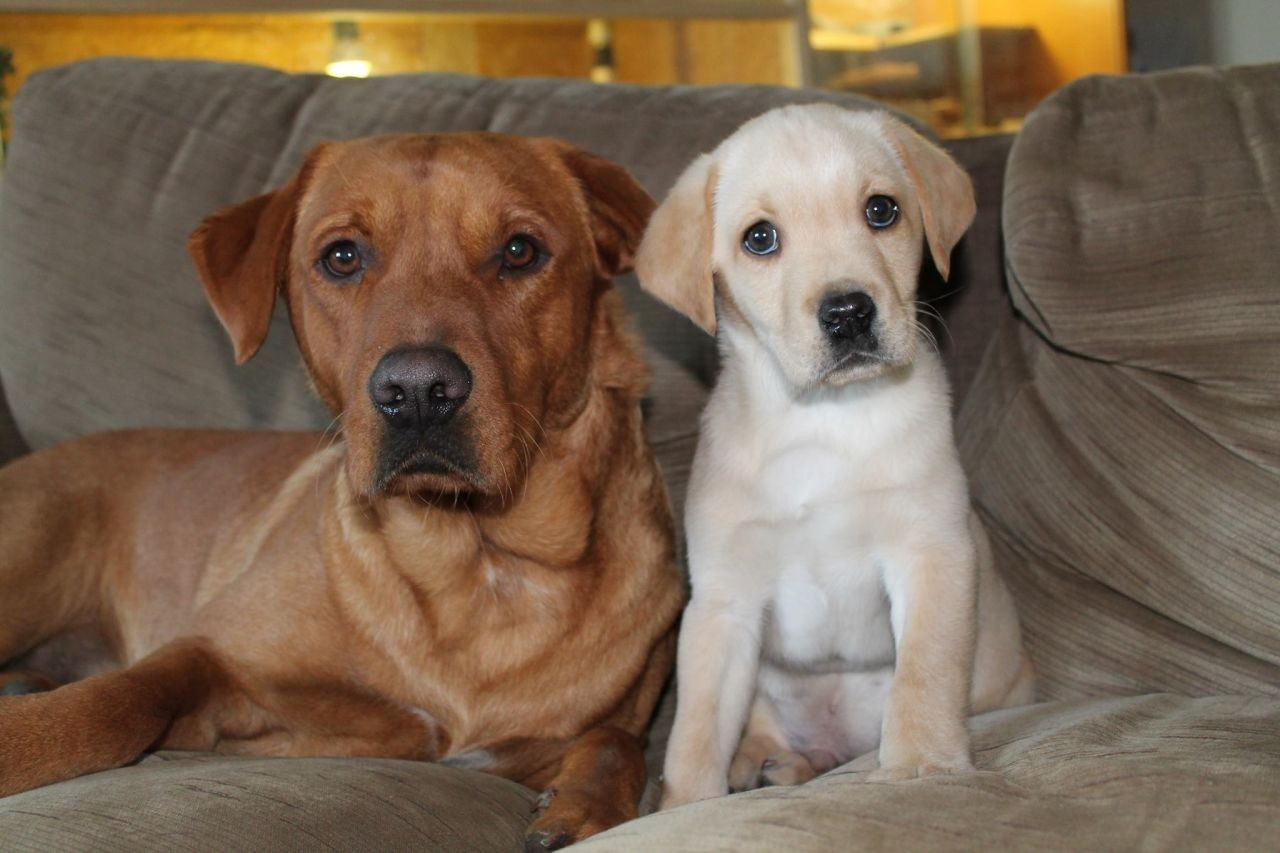
Ears: hanging, moderately close to the head, preferably at the back, slightly lower than the head; slightly higher than the level of the eyes. The ears should not be too big or heavy, but they should be in proportion to the head and extend to the inside of the eyes when pulled forward.
Eyes: sharp, friendly eyes show good temperament. Smart and smart are the characteristics of this breed. The eyes are of medium size and are well separated, neither prominent nor deep. Black or yellow dogs have brown eyes, while chocolate dogs have brown or hazel eyes. Black or yellow eyes make expression dazzling and undesirable. Small eyes, eyes that are too close to each other, and round, protruding eyes are not typical of the breed. Black or yellow labrador retrievers have black rims and chocolate labrador retrievers have brown rims. Lack of pigmentation around the eyes is disqualification.
Labrador neck, topline
Neck: the neck has the correct length, allowing him to easily complete the retrieval work. It is well muscled and has no dewlap. The neck is solidly raised from the shoulder blades and moderately arched. A short, thick neck or "sheep's neck" is wrong.
Topline: the back is strong, and the topline (from the withers to the hips) is level when standing or exercising. In any case, as a sporting dog, the waist clearly shows elasticity.
Labrador body
The Labrador Retriever has a short articulation and is delicate from well supported ribs to a moderately broad chest. The Labrador Retriever's chest should not be too narrow to appear empty between the forelimbs; nor should it be too wide to look like the front of a bulldog. The correct chest configuration is a slight thinning between the forelegs, allowing the forelegs to move freely. It is wrong to have a chest that is too wide or too narrow to prevent effective movement and sustained endurance. Flat chest is not a typical characteristic of this variety. The same is not the case with rounded ribs or barrel chests. The curve of the lower abdomen of adult dogs is almost straight or slightly raised. The waist is short, broad and strong, extending to a very developed, powerful hindquarters. Viewed from the side, the Labrador Retriever has a well developed, but not exaggerated, chest.
Tail: the tail is a unique feature of the breed. It is very thick at the root and tapers to the tip. Medium length, length not to extend beyond hock. The tail has no feathery feathers and is surrounded by a thick, short, thick coat of the Labrador retriever dog, resulting in a peculiar round appearance, described as the "otter" tail. At rest or during exercise, the tail is an extension of the topline. It may be held cheerfully, but it cannot be curled at the back. A tail that is too short or too long and thin is a serious defect. The tail is well coordinated with the overall Labrador Retriever, forming a flowing curve from the top of the head to the tip of the tail. It is disqualification to cut off the tail or otherwise change the natural length or posture of the tail.
Forequarters: the forequarters are well muscled and well aligned with the hindquarters. Scapula: the shoulder blade is tilted back, long and sloping, at an angle of about 90 degrees to the upper arm, allowing him to easily move the forelimb for maximum extension. Ideally, the length of the shoulder blade is approximately equal to the length of the upper arm bone. Too straight shoulder blades, too short upper arm bones, too heavy muscles or anti shoulders, all of which hinder the ability to move freely, are incorrect.
Forelegs: Viewed from the front, the forelegs are straight and the bones are strong. Too much or too little bone is not desirable. Short legs or heavy bones are not typical features of this breed. Viewed from the side, the elbow is just below the shoulder of the horse, and the forelimb is perpendicular to the ground and in a proper position under the body. The elbows are close to the ribs and show no sign of loosening. Elbow joint protrusion or "stretched", hindering the movement of stretching, is a serious defect. But short, slightly oblique to legs.
Feet: strong and compact, with arched toes and well-developed pads. The claws can be removed. Open feet, rabbit feet, joint protrusion, or feet bending inward or outward are serious defects.
Hindquarters: the Labrador Retriever's hindquarters are broad, muscular, clear from the hip to the hocks, good knee rotation, and short and strong hocks. Viewed from the rear, the hind legs are straight and parallel to each other. Viewed from the side, the angle of the hindquarters is in harmony with the forequarters. The bones and muscles of the hind legs are strong, the knee joint angle is moderate, and the thighs are strong and clear. The knee joints are strong and will not slide when moving or standing. The hocks are strong, low in position, and do not slide or over stretch during exercise or standing. The angle of knee joint and knuckle reach the best position, which can balance the driving force and traction force well. When standing, the toes of the hind legs are slightly behind the hips. It is not a typical feature of this variety that the angle is too large to cause the topline to incline.
Feet: strong and compact, with arched toes and well-developed pads. Cattle legs, extended knuckles, sickle legs or excessive angles are serious structural problems and defects.
Labrador coat
The Labrador Retriever has a distinctive coat. The coat is short, straight and very dense, giving the fingers a fairly hard feel when touched. The Labrador Retriever has a soft, weather resistant undercoat that protects it in water, in cold places, in a variety of terrain conditions. A slightly wavy coat on the back is permissible. A woolly coat, a soft silky coat, or a sparse, smooth coat is not characteristic of the breed and is a serious defect.
Labrador color
Labrador Retrievers come in three colors: black, yellow and chocolate. Any other color or color combination is a disqualification. Small white patches on the chest are permissible, but not ideal. White hair due to old age or scars should not be misinterpreted as spots.
Black: all black, black with spots or black with brown stripes are disqualified.
Yellow: yellow color is allowed from Fox red to light cheese color, with different colors in ears, back and lower abdomen.
Chocolate: light to dark chocolate is allowed. Chocolate with spots or brown stripes is disqualification.
Labrador action
The Labrador Retriever's movements are relaxed and relaxed. When looking at a dog coming towards him, there is no sign of his elbow going out. To be more precise, the elbows and legs are relatively neat and not too close to the body. Straight forward without pacing or interlacing. The legs form a straight line and all parts move in the same plane. On the contrary, from the back, an important impression is that the hind legs almost move in the same parallel line with the front legs, and the knuckles are fully involved in the work, with good bending and very powerful. Viewed from the side, the shoulder blades are free to move, very relaxed, the front legs extended forward, close to the ground, short and undulating movements, and raising the knees show that the shoulder blades are too straight, rowing shows long and weak bones, and the short and artificial hindquarters gait shows that the hindquarters structure is too straight; all these are serious defects.
The wrong gait includes: interlacing step, detour to the side, interlacing, high leg raising, rowing, short and undulating movements. These are serious defects.
Labrador temperament
The temperament of a real Labrador Retriever is just like the "otter" tail of this breed. The ideal temperament is gentle, outgoing, naturally easy to adjust; eager to please the host, and not aggressive to humans or other animals. Labrador Retriever is very attractive to people. His elegant behavior, intelligence and adaptability make him an ideal dog. Aggressive tendencies to humans or other animals, or obvious signs of shyness in adult dogs, are serious defects.
Labrador disqualification
1. Any deviation from the height range specified in the standard.
2. The overall pink nose or lack of any pigment.
3. Lack of pigment around the eyes.
4. Cutting the tail or changing the natural length and posture of the tail by any other means.
5. Any color or combination of colors other than black, yellow, and chocolate as described in the standard.