Accidentally cut hands by paper, scratches, abrasions, scalds, these are common skin trauma, may be a lot of people don't care. But experts remind, no matter how small the wound, fast care is the key, the faster care, the more can avoid scar. Let's have a look.
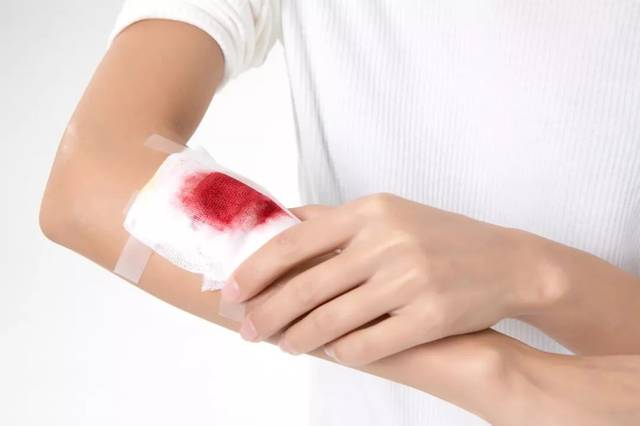
Processing steps
1. Clean the wound: rinse the wound with flowing normal saline. Wipe the skin around the wound with a clean cloth and soap. Be careful not to put soap in the wound, it will hurt the skin. Then use gauze or tweezers to clean the dirt in the wound.
2. Stop bleeding: don't think bleeding is a bad thing, it can help clean the wound. Smaller wounds will soon stop bleeding automatically. If you want to stop bleeding quickly, it is best to press the wound with a clean cloth attached to a harder object. If the wound is on the limbs, raise the injured part so that it is relatively higher than the heart, and the blood will slowly stop.
3. Hemostasis is difficult, use bandage: use a hard object to compress for more than 10 minutes, and if the bleeding has not been stopped, bandage should be used. Bandages can help heal wounds that are not closed. If the wound is easily soiled or easily rubbed at any time, medical bandage and adhesive tape can be used to bandage the wound. Keep the gauze clean and dry every day. If the wound is too deep to restore the edge, it needs to be sutured to avoid infection.
4. Dealing with blood scabs: for blood scabs, the best way is to do nothing. Wound scab can prevent contamination of dirty things, try to let the child do not buckle off the blood scab. When the wound heals, the blood scab will peel off automatically.
matters needing attention
1. When washing the wound, patients should try to keep relaxed and distract their attention;
2. If there is pain in the wound, you can take painkiller or spray Zhitong powder before cleaning the wound;
3. If there is pus in the wound, squeeze it with two cotton balls as far as possible;
4. If there is bleeding in the wound, a little pressure can be applied at the bleeding site to help stop bleeding;
5. If there is stench in the ulcerative wound, it means that there is necrotic tissue. For example, if the tissue has rotten meat, it can be washed with tap water under high pressure. When cleaning the wound, the rotten meat should be removed as far as possible, and then covered with activated carbon dressing to help absorb the odor;
6. If there is a tunnel or fistula in the wound, it should be filled with gauze to help lead out exudate;
7. When the wound tends to heal, skin hyperplasia can be seen. At this time, lipid water gel dressing should be applied to prevent the skin from Healing when the dressing is removed.
The principles of wound management are as follows:
All kinds of trauma, often cause skin and soft tissue damage, serious even amputated limbs. If the wound is treated correctly, it can heal quickly; on the contrary, it may fester and infect for a long time, and even be life-threatening due to complicated systemic infection, gas gangrene and tetanus. Therefore, the wound must be treated strictly and seriously.
Once the human body suffers from trauma, if the wound is not treated in time, it is easy to cause wound infection.
1. Hemostasis: it can stop bleeding in time according to the specific situation.
2. Bandage: wound dressing properly, can make it less bleeding, less pus, less pain. The bandage should be fast, accurate, light, firm, fast and quick, and the position should be accurate and tight; the light one should be light and not touch the wound; the bandage should be firm and tight.
Four Misunderstandings of wound care
1. Can alcohol prevent wound infection?
Correct solution: use alcohol to clean the wound once. Repeated use of alcohol on the wound will make the wound excessively dry, which is not conducive to wound recovery.
2. Small wounds don't need care?
Correct solution: as long as there is a break in the skin surface (blood can be seen), you should take care of it as soon as possible.
3. If the wound is not covered and "ventilated", will it recover faster?
Correct solution: if the wound is exposed and exposed to air, it will become dry and not conducive to recovery.
4. Scab on the wound indicates that it will be cured soon?
Correct solution: the wound scab, below the cell renewal is blocked, will cause the recovery time to lengthen.
Advice: if the wound has scab, do not tear the scab. Because touching and rubbing the wound, or making the wound infected, is not conducive to wound healing.